As with all of my trips to new countries or regions I like to look up what the main natural hazards are in a place and if there are any unique
Mongolia is a country of climatic extremes rather than dramatic geological disasters. It doesn’t experience the frequent earthquakes or hurricanes that affect many parts of the world. But it does face some of the harshest weather on earth. And the country’s nomadic culture evolved largely as a way of coping with these hazards.
Dzud
I’m going to start with the natural disaster that I’m the least familiar with – the dzud (pronounced ‘zood’). This is the most famous Mongolian hazard and is unique to the terrain and climate of the country. A dzud occurs when a poor summer leaves livestock undernourished and is then followed by an exceptionally harsh winter with deep snow, ice or prolonged extreme cold. This prevents animals from reaching the grass. There are several types of dzud – white (deep snow buries grazing), black (little snow but severe drought resulting in no water), iron (rain freezes into a thick ice over the grass) and cold (prolonged temperatures below -40). Often several types of dzud occur together. Livestock can starve by the millions despite standing on pasture.
In 2009-2010 a catastrophic dzud occurred, in which 8-10 million animals died (roughly a quarter of Mongolia’s livestock) and thousands of herding families lost their livelihoods. Many permanently migrated to Ulaanbaatar, contributing to the city’s rapid growth. More recently in the winter of 2023-24 more than 7 million animals were lost.
Extreme Cold
Mongolia is one of the coldest inhabited climates on Earth. Winter temperatures commonly reach -30 in most of the country, and occasionally -50 in some regions. The high altitudes, clear skies and distance from oceans allows heat to escape rapidly overnight. The cold affects transport, power systems, livestock, water supply and human health. In the capital it is common to experience severe air pollution as many households in the ger districts heat with coal and wood, and the cold, still air traps smoke in the valley, creating some of the world’s worst winter air quality.
Drought
Summer droughts are becoming more frequent. The impacts include poor pasture growth, reduced river flow, drying wells and increased risk of dzud the following winter. Climate change appears to be increasing both drought frequency and temperature across Mongolia.
Dust Storms
Spring often brings enormous dust storms from the Gobi Desert. Strong winds can lift millions of tons of dust into the atmosphere. These storms reduce visibility, sometimes to just a few meters, disrupt flights and affect air quality as far away as Japan and South Korea. They are becoming more common due to desertification and drought.
Wildfires
Grassland fires are common during dry years. Because Mongolia has vast open steppe, fires can spread for hundreds of kms, strong winds accelerate them and they threaten livestock and remote communities. Lightning starts some of these fires, whilst others are caused accidently by people.
Flooding
Although Mongolia is generally very dry, flash floods do occur. Mountain valleys around places such as Terelj National Park can experience sudden floods after intense summer thunderstorms. Ulaanbaatar also suffers from urban flooding because heavy rain fall falls on hard ground and drainage infrastructure is limited. Many of the ger districts that surround the capital lack proper stormwater systems but have been built on flood plains or in small valleys. The most recent significant urban flooding occurred in July 2023 during which the Tuul and Selbe rivers overflowed after days of heavy rainfall. Flood waters entered homes, apartment basements and roads, damaged bridges and utilities and forced the evacuation of more than 20,000 people.
Earthquakes
Mongolia is actually one of the more seismically active countries in inland Asia as it sits near the collision zone between the Indian and Eurasian tectonic plates. These stresses are released on large strike-slip faults running across Mongolia. Whilst uncommon, major earthquakes do occur, although the overall risk is considered medium. The highest risk is in western, central and southern regions. Over the last 30 years, scientists have discovered several active faults within 40-200km of Ulaanbaatar and it is estimated that these faults are capable of generating earthquakes around Mw 6.5-7. This is not insignificant and would cause significant shaking in the city. This is important because nearly half of Mongolia’s population now lives in the capital and many apartment blocks were built during the Soviet era.
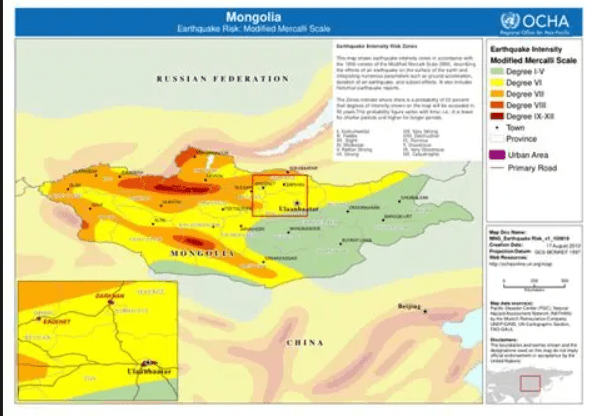
The most famous earthquake in recent records in the 1957 Gobi-Altai earthquake, measuring Mw 8.1 and is one of the largest continental earthquakes ever recorded. It produced surface ruptures stretching hundreds of kms. It occurred in southern Mongolia in today’s Gobi-Altai region and killed around 30 people (this part of Mongolia has a very low population).
Desertification is one of Mongolia’s biggest long-term environmental hazards but I’m going to write about that in a few days once we have travelled through the Gobi Desert! I’ll also tackle the question of climate change separately!
What is probably most interesting to talk about in relation to natural hazards in Mongolia is how nomadic life has evolved to manage risk. Rather than keeping permanent farms, herders traditionally move several times a year between seasonal pastures. If one area suffers drought, deep snow or poor grazing, they can relocate to another. Families also maintain hay reserves, co-operate with neighbouring herders and breed hardy animals to spread risk. Even today, despite modern technology, the weather remains the greatest challenge to life on the steppe, and a single dzud can undo years of hard work.


Leave a Reply