Before I leave Kazakhstan I wanted to capture a brief summary of the history of the country, especially as at some points it becomes complicated with various empires and khanates occupying different parts of the country. I have really enjoyed my time here and am glad I picked one of the longer routes that are available for small group tours that included more stops in Kazakhstan. For anyone thinking to travel here, pick a tour that explores more of the country than just Almaty.
Kazakhstan is by far the largest of the Central Asian countries and is actually roughly the size of Western Europe. It is the 9th largest country in the world, and the largest one that is landlocked. It borders Russia to the north, China to the east, and Kyrgyzstan, Uzbekistan and Turkmenistan to the south. It also has access to the Caspian sea to its west.
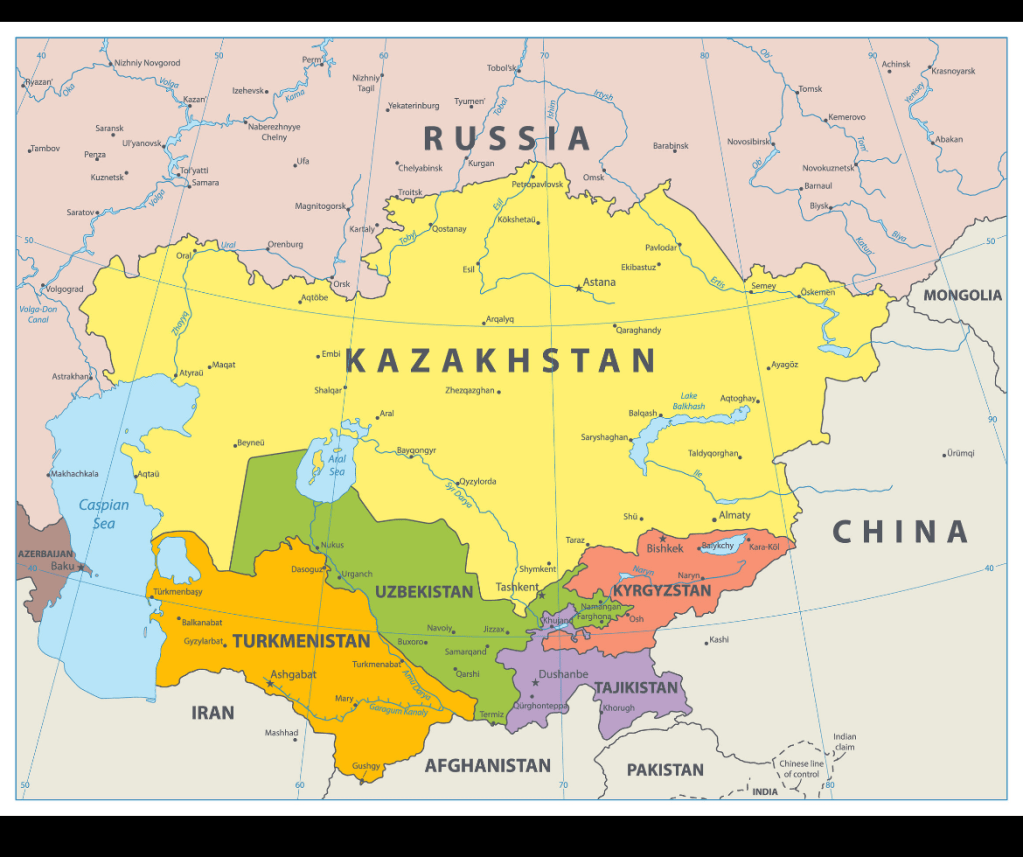
It is a very empty country. 45% of the country is never-ending flat steppe grassland. And 44% is desert and semi-desert. You can travel for hours across both the steppe and desert without passing even the smallest of settlements. As a result it has one of the lowest population densities in the world at just 7 people per km^2. For comparison, the UK population density is 280 per km^2. Most people live in cities, with the major ones being Astana, Almaty, and Shymkent. I could easily sense this emptiness as I landed in Astana. The steppe stretched into the horizon as far as the eye could see.

The country has a population of 20 million people and an amazing total of ~130 different ethnic groups. The major ethnicity is Kazakh who form 65% of the population followed by Russian at 20%. The huge ethnic diversity (including some very small communities that are sometimes just a few thousand people) is a result of a few driving forces. Firstly the country sits along a nomadic migration corridor that many different ethnicities have passed through for centuries. Secondly, during the Russian Empire many people were encouraged to move and settle here. Thirdly, entire ethnic groups were deported to the country during the Soviet era. For example, Volga Germans, Chechens and Crimean Tatars. And finally in the 50’s and 60’s hundreds of thousands of Russians, Ukrainians and Belarusians moved here to farm the steppe under the ‘Virgin Lands Campaign’.
As a result of this extremely diverse population the government has set up the Assembly of the People of Kazakhstan which ensures minority groups have a voice in the nation. That said, everyday life is dominated by a Kazakh-Russian culture. During my time here it has been easy to see that whilst there are mosques and churches everywhere, religion does not dominate society, but rather sits alongside it. The country is secular and its flavor of Islam is different from the Middle East. At the end of my trip I am going to write a more general blog on Islam in Central Asia, but I need to explore a bit more before I commit my thoughts to paper.
Ok so back to the history. There is archaeological evidence that hunter-gathers were in Kazakhstan hundreds of thousands of years ago. And that by the Bronze age (2000-800 BC) there were farmers and metal workers. This is referred to as the Andronovo culture. The Saka (Scythians) were in southern Kazakhstan from around 1000 BC (e.g. Golden Man) and later on the Wusun and Hun tribes arrived. This the time when nomadic confederations started to form and steppe culture started to flourish.
Then we move to the time of the Turkic empires:
- In the 6th century, the Turkic tribes formed a Khanate stretching across Central Asia. And Kazakhstan sat right at the crossroads of the Silk Road connecting China with Persia and Europe.
- In the 8th and 9th centuries Islam spread across the region, mixing with local steppe culture and traditions.
- Then in the 13th century Genghis Khan’s Mongol empire arrived, conquering the steppe and the area of Kazakhstan became known as the Golden Horde. Mongol rule blended with Turkic culture, creating new khanates and clans.
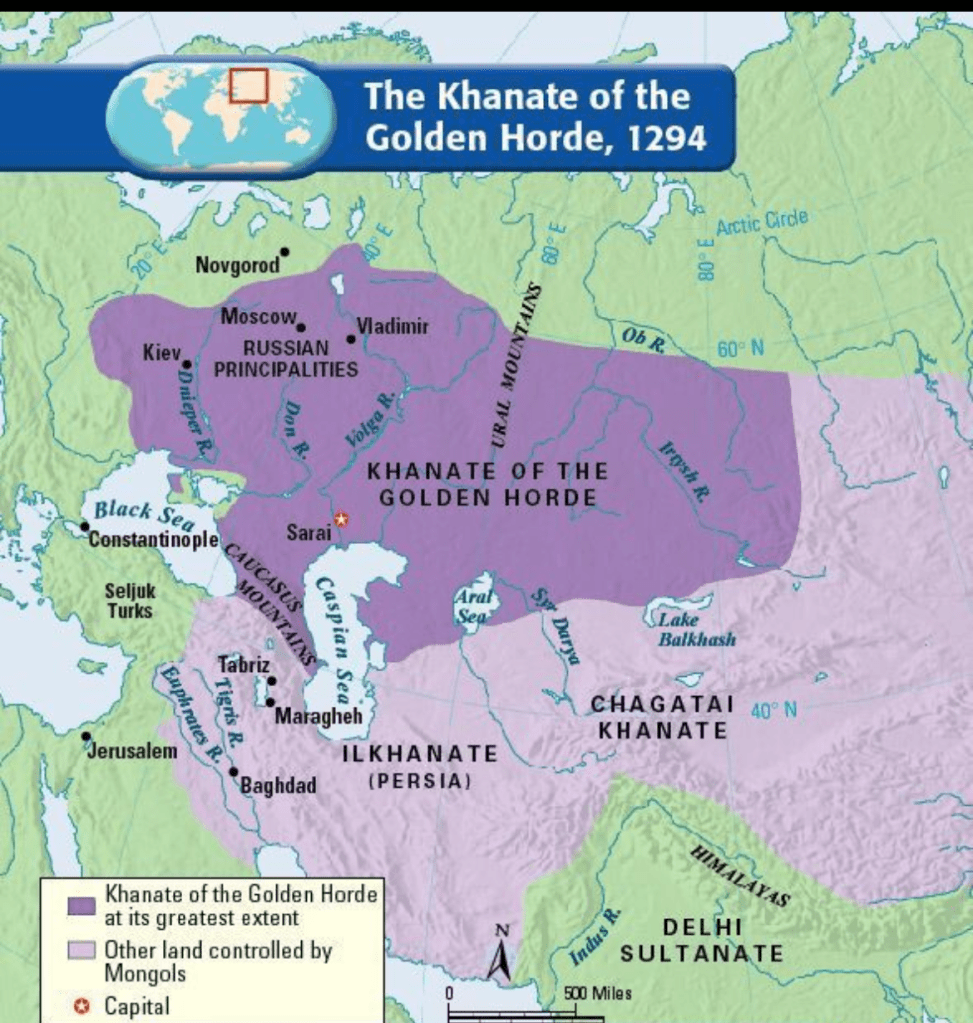
- In the 15th century the Kazakh Khanate emerged which is when a distinct Kazakh identity started to form.
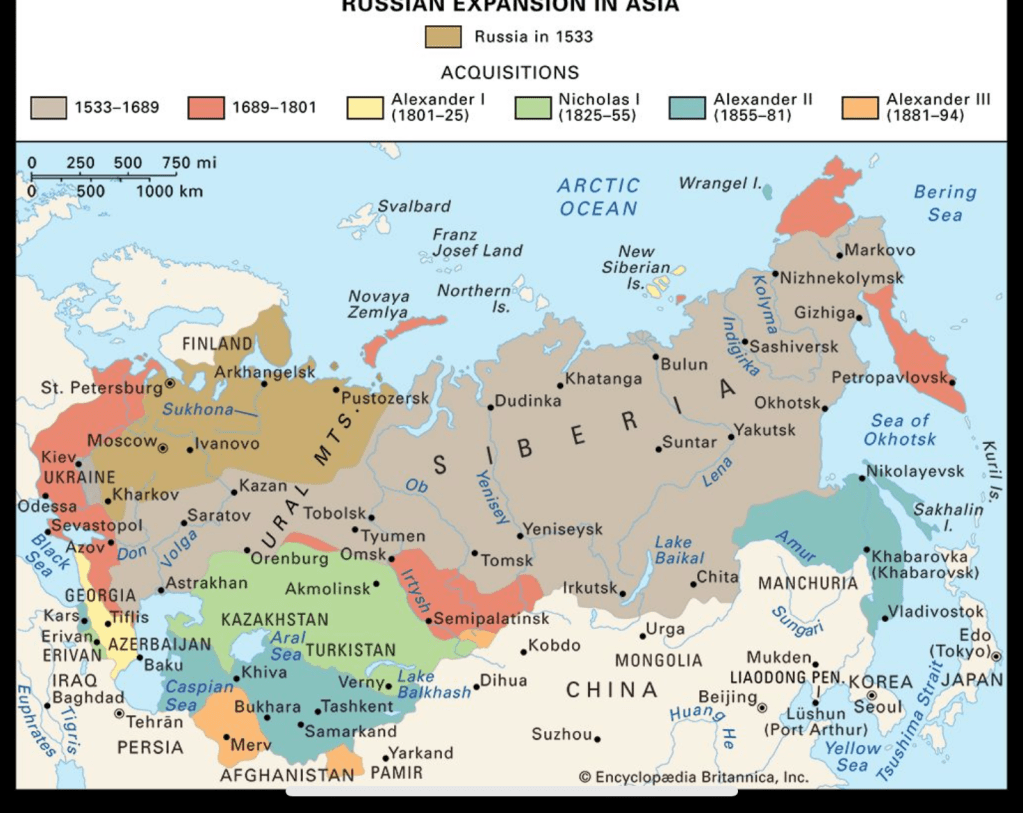
Then we move into the the 18th century when the Russian Empire expanded into Kazakh territory. At first they ruled via influence but over time this developed into direct rule. Important frontier towns like Verny (Almaty) were established. At this time many Russian and Ukrainian farmers were encouraged to move to Kazakhstan for farming.
After the Bolshevik revolution, Kazakhstan became part of the USSR. Collectivization farming was forced upon the population, which like everywhere else failed, causing a famine in the 1930s and the death of millions of Kazakh people. Many significant USSR projects happened in Kazakhstan. Including nuclear testing in an area called Semipalatinsk which had serious health and environment implications for the local population. Kazakhstan is also where Baikonur Cosmodrome is based – the launch site for Sputnik and Yuri Gagarin’s first human space flight. As I have written about in earlier blogs, Kazakhstan heavily contributed to WWII both in terms of people and resources. As well as being somewhere that many exiles were sent to live out their lives in Gulags.

After the collapse of the USSR, Kazakhstan declared independence in 1991. Nursultan Nazabayev became the country’s first president and ruled for three decades. During this time, the government used its vast oil, gas and mineral wealth to grow its economy and it is now the richest country in Central Asia. Nazarbayev oversaw huge economic growth, attracting foreign investors and promoting balanced diplomacy with Russia, Europe, China and the US. For a country with such broad ethnic diversity, he ensured overall stability unlike some other Central Asian countries post-independence. However he is also criticized as an authoritarian. And you can sense from the number of things named after him (the airport, streets, monuments etc) that there is a bit of a ‘cult of personality’ surrounding him.
He resigned in 2019 handing over power to his chosen successor Kassym-Jomart Tokayev, which is pretty rare for an authoritarian ruler. However, a little research tells me that he sat behind the scenes and retained influence. This was a clever thing for him to do, as his stepping back (even though he wasn’t really) ensures his legacy will be of a great leader and not someone who hung onto power until his dying breath.
In 2022 there were nationwide protests over fuel prices and other cost of living issues and from that point Nazarbayev’s lingering influence was removed. Tokayev has promised political modernization with term limits and more democratization going forward (it is still really a one-party system). He is also taking a neutral role when it comes to supporting Russia in the Ukraine war as the country wants to continue to develop and strengthen ties with China and the EU. It is also diversifying away from oil into renewables, finance and tech.

 Colette's Grand Detour
Leave a reply to Davidoluwadamilare Cancel reply