San Pedro de Atacama is one of the best stargazing locations on earth. It has a combination of geography, climate and altitude that creates perfectly clear skies and excellent conditions for seeing the stars.
Why is it so good?
- Extremely dry climate – The Atacama desert is the driest non-polar desert in the world. With almost no humidity, there’s virtually no moisture to scatter light, resulting in crisp, sharp stars.
- High altitude – San Pedro sits at around 2,400m, which removes a lot of the Earth’s atmosphere between you and the stars. Less atmosphere = better stargazing.
- Little, to no light pollution – Outside of town, the desert is pitch black, giving you perfect dark-sky conditions.
- Stable climate – Year-round high pressure means predictable weather, very few clouds and low atmospheric turbulence.
The conditions are so good that many world-class observatories have chosen to build their telescopes here. ALMA (Atacama Large Millimeter/submillimeter Array) is the most powerful radio observatory in the world, and lies 50km east of San Pedro on a 5,000m plateau. It consists of 66 radio antennas working together as one giant telescope. It is the single most expensive ground-based astronomy project ever built. There is also the Paranel Observatory, home to the Very Large Telescope (VLT) – one of world’s most powerful optical telescopes. This observatory is famous for imaging the black hole at the center of the Milky Way. And the world’s most advanced gamma-ray observatory is currently under construction.
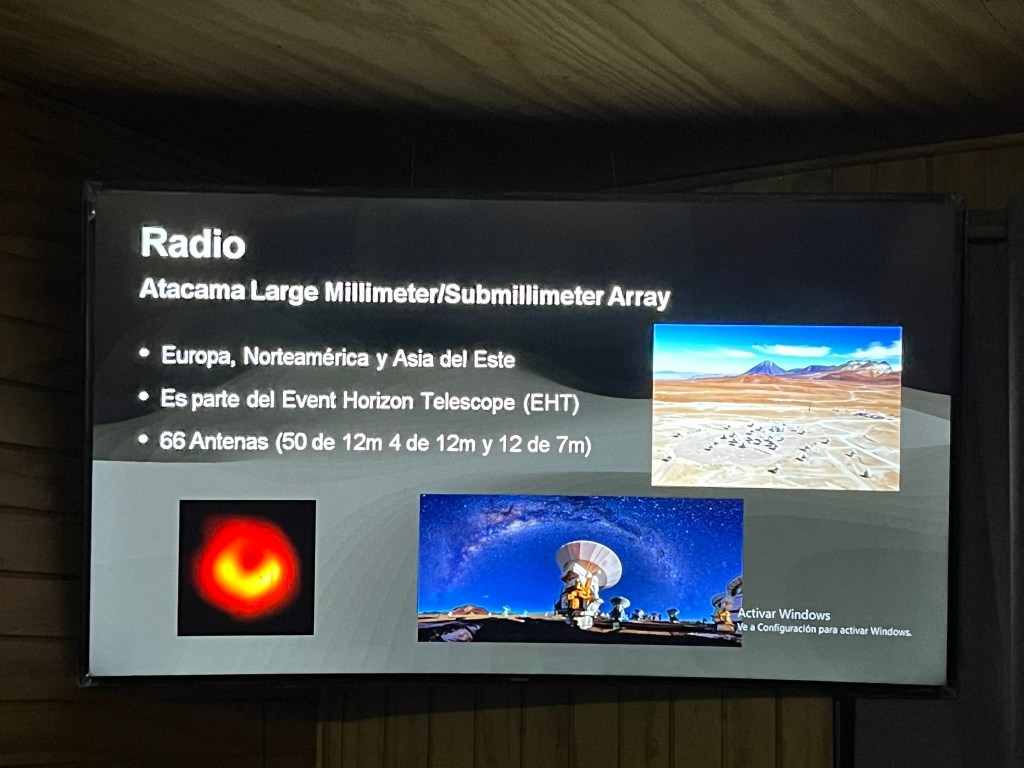
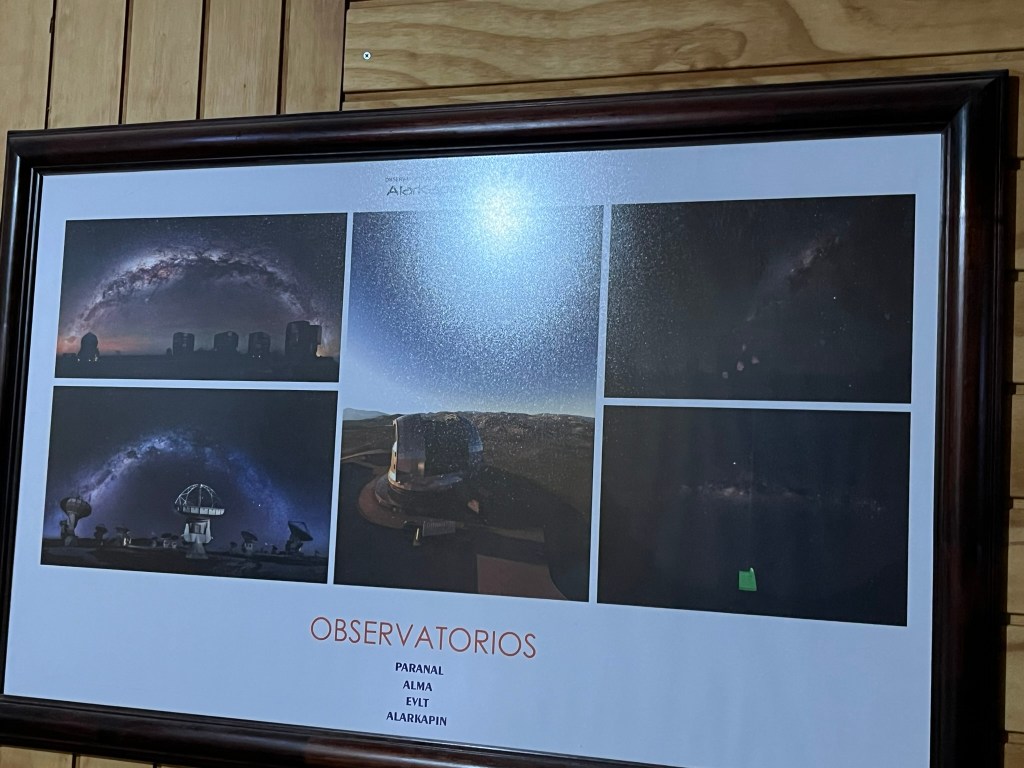
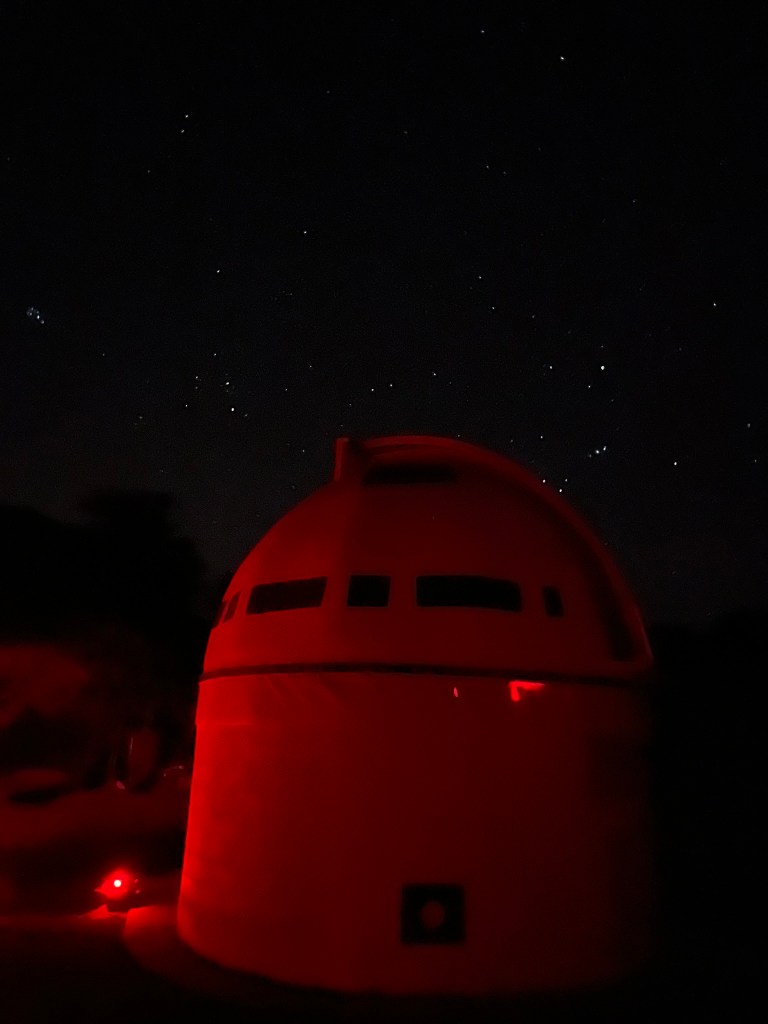
Tonight we booked onto a stargazing tour at one of the local ‘night-sky tourism’ observatories (much much smaller than the ones I mentioned above), with pick up at 9pm and drop off back to the hotel close to midnight. We started with a short talk about how the universe is organised and the huge distance between objects in space. We all felt suitably small and inconsequential after discussing that our star was one of trillions in our galaxy, and that our galaxy was one of trillions in the observed universe.
Next we headed out into the darkness, and after a couple of minutes of letting our eyes adjust, our guide started to point out major features in the sky that could be seen with the naked eye. It isn’t the right season to see the Milky Way clearly, but you can see the Magellanic clouds really well, as well as Saturn. And an enormous number of stars. The guide estimated there were probably 5000 stars visible to the naked eye at this time of year. And it increases to around 8000 during Chile’s winter season. Some of the photos from during the winter look absolutely incredible, with the Milky Way clearly visible, sweeping across the sky.
There were 3 huge 150x magnification telescopes set up, that let us take a closer look at some of the objects in the sky. The guides were great and kept repositioning them so we could see a variety of stars, including super clusters and twin stars. We even saw three shooting stars as we waited our turns to look into the telescopes.
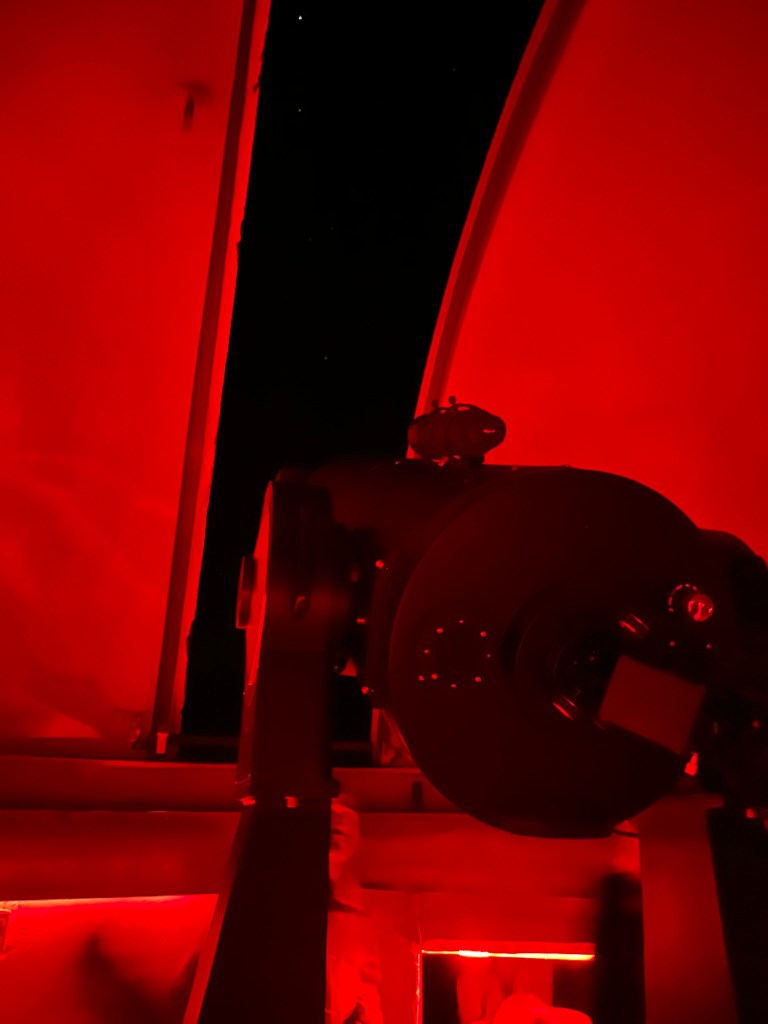
The highlight of the evening was heading into the observatory where there was an even bigger telescope. I must admit I had thought the evening would mainly consist of just looking up at the sky with our eyes, so it was such a brilliant surprise that we were using proper telescopes. First we looked at the Tarantula Nebula, an emission nebula. This is a star nursery area inside the Large Magellanic Cloud (a dwarf galaxy orbiting the Milky Way). It is 160,000 light years away and 650 light years in diameter. With the telescope you can see spider web-like masses of gas.
Next up we looked at 47 Tucanae, a massive globular cluster containing over a million stars. It is 13,000 light years away and located next to the Small Magellanic Cloud. When you look through the telescope you see a bright, round, glowing ball surrounded by a kaleidoscope of shimmering stars. And finally we looked at Saturn. For me this was the highlight as it was so recognizable and many of the group let our ‘wow’s’ when they looked through the telescope. You could really clearly see the planet’s rings.
We wrapped up the evening with taking photos of the night’s sky with an extra long exposure on the guide’s professional camera. A great evening and another must-do activity whilst staying in San Pedro. There are lots of tour companies to choose from who offer stargazing, so be sure to pick one that uses big telescopes.

 Colette's Grand Detour
Leave a comment