Nepal’s flag is one of the most distinctive as it is the only non-rectangular national flag in the world! It is made up of 2 overlapping crimson-red triangles with blue borders. This is known as a double-pennon and is said to symbolize the Himalayas and the country’s 2 major religions; Hinduism and Buddhism. The crimson red is Nepal’s national color and symbolizes bravery and victory. The blue border represents peace and harmony.
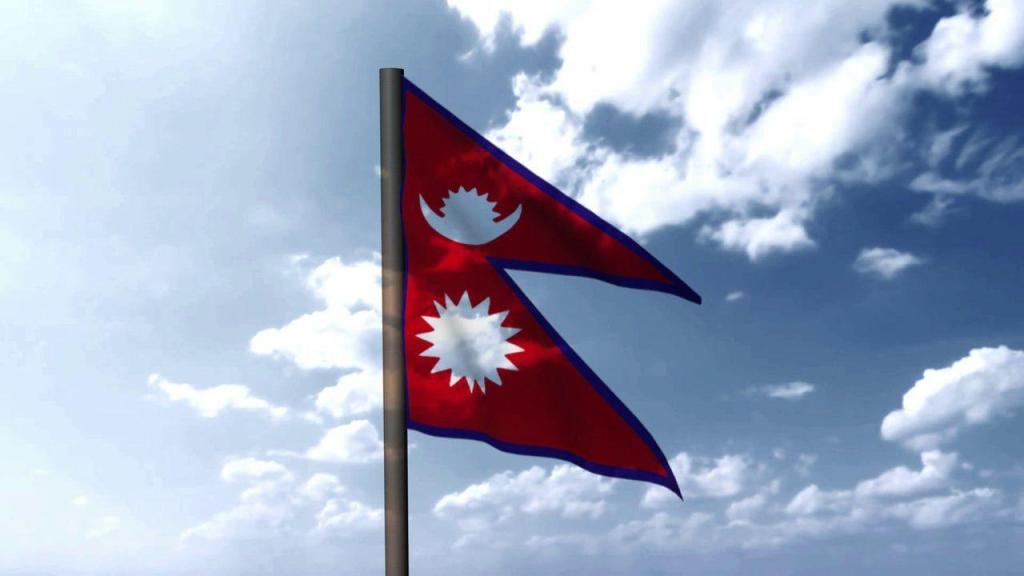
In the upper triangle there is a white moon with 8 rays and a crescent attached below. In the lower triangle there is a white 12-pointed star. These 2 symbols are celestial bodies and represent permeance. The moon symbolises the calm nature of the Nepalese and the sun represents fierceness and resolve. Together they signify Nepal’s hope that as a country it will last for as long the sun and the moon exist.
The design of the flag is rooted in a combination of Hindu and Buddhist symbolism. The triangular pennon was a common design in historical South Asian flags and standards. The current design was officially adopted in 1962 when the country established its constitutional government. Before that it had the same double-pennon shape but different symbols inside of these.
Interestingly it is a flag that is incredibly complex to reproduce accurately because the constitution of the government outlines the exact detailed geometric instructions of all the lines, circles and ratios to be used to ensure the flag is drawn correctly.
 Colette's Grand Detour
Leave a comment