Our guide spent some time whilst we were in Almaty explaining the meaning behind Kazakhstan’s national flag and emblem.
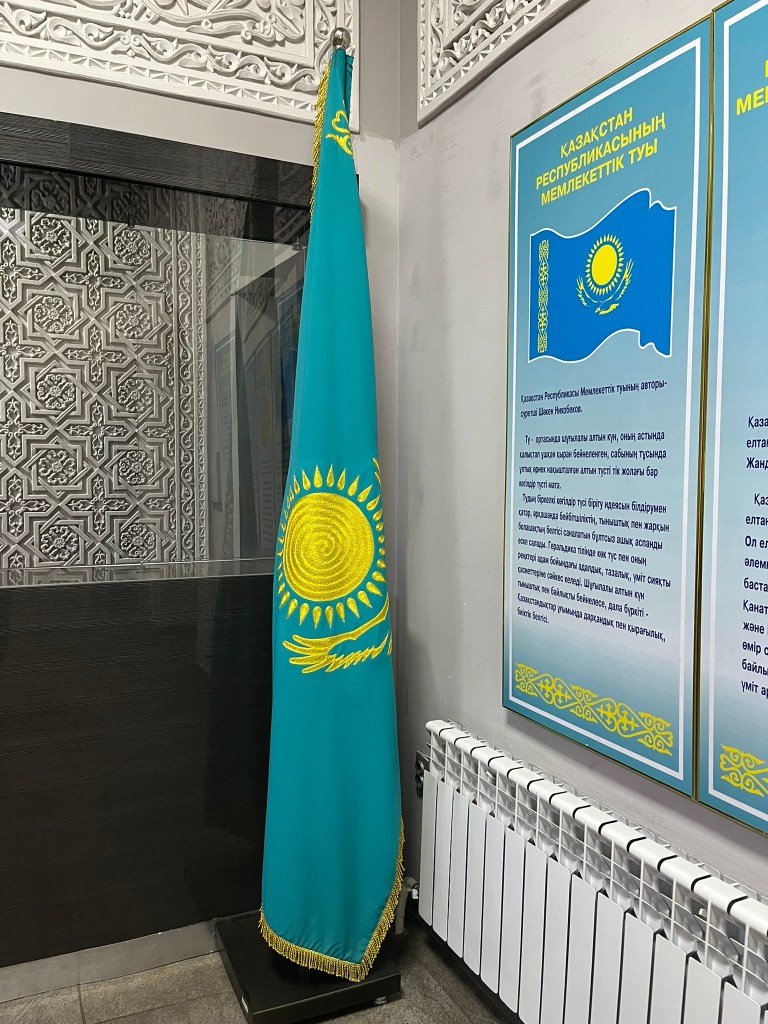
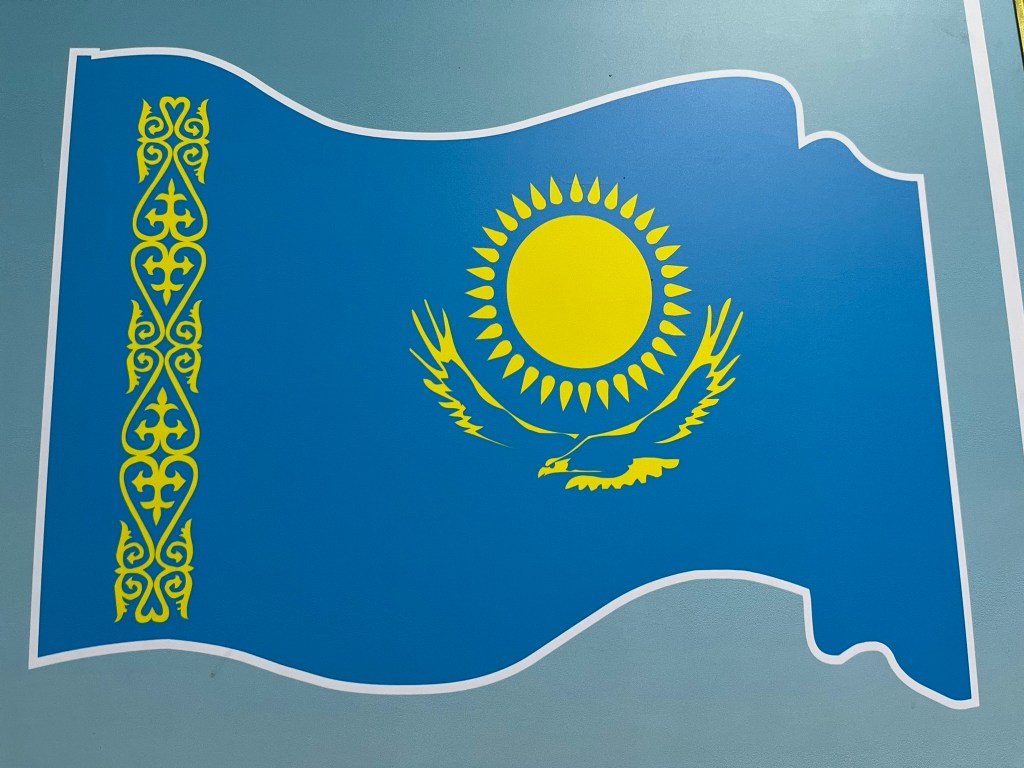
The flag’s blue background represents peace and ethnic unity. With over 120 ethnicities in Kazakhstan this is an important part of daily life. The golden sun in the center represents life and its 32 surrounding rays are in the shape of wheat grains representing the importance of agriculture in the country. The golden eagle represents spirit and strength. And finally the ornament that runs down the left-side of the flag represents Kazakh art and cultural heritage. The pattern is known as ‘koshkar-muiz’ which is meant to depict ram’s horns and is a traditional local motif. We have also seen this motif in many other places like decorations on apartment blocks in Almaty. The flag was first used in 1992 after Kazakhstan’s independence from the USSR in 1991.
The national emblem is circular to echo the shape of a yurt. The shanyrak (the wooden crown of a yurt) sits in the center of the emblem and the supporting structure of the yurt radiates outwards. This is meant to represent the Kazakh people and their cultural heritage. On each side there is a winged mythical horse called a tulpar, representing bravery, strength and aspirations for the future.
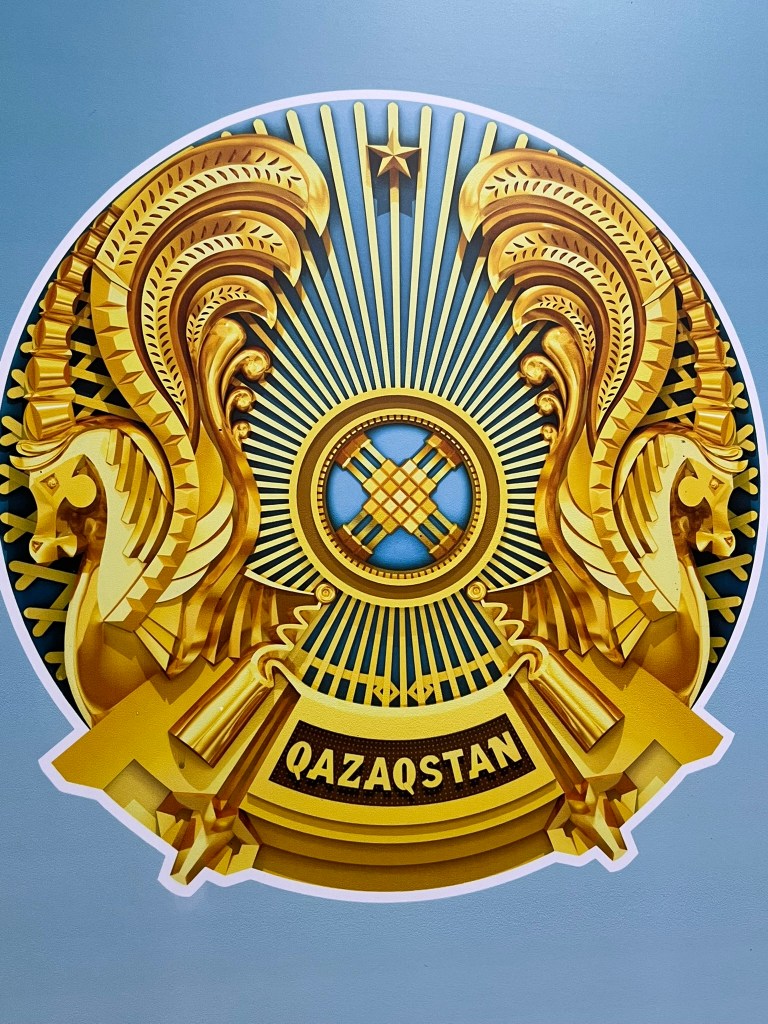
Interestingly Kazakhstan is planning to change its name and has already submitted the request to formalise this to the UN. To be more accurate, it is planning to change the spelling of its name to Qazaqstan. Kazakhstan is moving from the cyrillic alphabet to the latin alphabet and so the spelling change is to reflect how the name is pronounced using latin letters. The change in alphabet (something that Uzbekistan is doing as well) is driven by the country’s wish to ‘de-russify’ and give themself their own distinct national identity different to Russia. It also makes sense in an increasingly global economy and society. The latin alphabet dominates international communication and it makes it easier for foreigners to read, learn and use which is good for business investment. Finally, it is just way more practical in the digital world we live in. Latin is much more compatible with modern technology.
The goal is that by 2031 the younger generation will be fully fluent in using Kazakh with the latin alphabet and cyrillic will slowly fade away. This is going to be a tricky transition for an older generation who know nothing but cyrillic.
 Colette's Grand Detour
Leave a comment