Day 9 (5th August 2025)
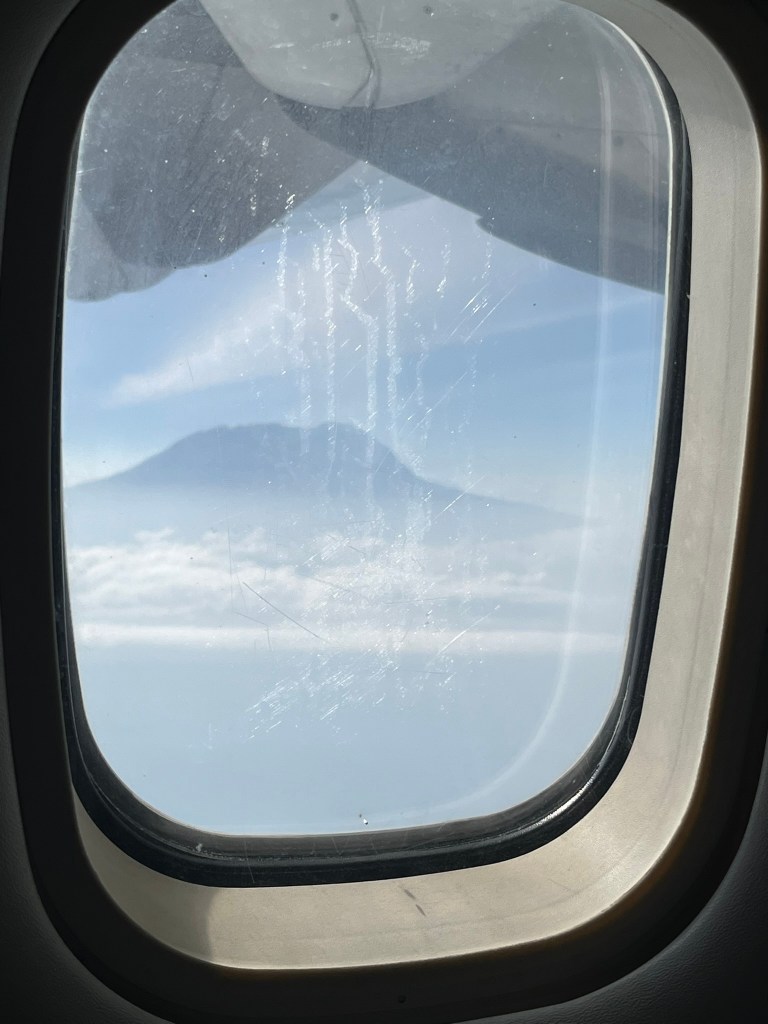
I have now arrived in Tanzania and will be here for the next 9 days. We travelled from Nairobi to Arusha (where most northern circuit safaris start) with a quick 1 hour plane ride this morning. The highlight of the flight was spotting Mount Kilimanjaro so clearly out of the window!
We will be visiting 3 National Parks in Tanzania – Lake Manyara, the Serengeti and Ngorongoro crater. Along the way we will visit Olduvai gorge where the Leakey’s discovered early hominid fossils, a project in a Maasai village that supports the provision of clean cookstoves to communities, and take a guided walking tour of a local village and experience a locally cooked meal.
I looked a little into the history of Tanzania this afternoon, to start to get an understanding of the country. Fossil evidence has been found showing early human ancestors in the Ngorongoro area up to 2 million years ago, giving it the name of the ‘Cradle of Mankind’. We will visit this when we go to Olduvai Gorge during the trip.
Ancient communities such as the Bantu-speaking people migrated to the region around 1000 CE, bringing with them agriculture, ironworking and social organisation. In the north, groups like the Iraqw established themselves and developed terracing and irrigation. And in the Great Lakes region, chiefdomes and kingdoms emerged.
From ~1000-1500 CE a thriving maritime network developed along the Swahili coast, with city-states such as Kilwa, Zanzibar and Bagamoyo developing thriving Indian Ocean trade, and exchanging gold, ivory, slaves and spices with the Arabs, Persians, Indians and later, Chinese. This is the main driver for the spread of Islam along the coast of East Africa. The Portuguese arrived in the early 1500s, who were then eventually displaced by the Omani Arabs, who moved the capital to Zanzibar in the 1840s. At this time thousands of enslaved Africans passed through Bagamoyo, onto Zanzibar en route to the Middle East and Asia.
During the ‘Scramble for Africa’ in the late 19th/early 20th century it was claimed by the Germans and it formed part of Germany East Africa along with Rwanda and Burundi. Harsh colonial rule and the German’s only interest being resource extraction resulted in the Maji Maji Rebellion where over 250,000 Africans died. After Germany was defeated in WW1, Tanganyika became a British mandate territory under the League of Nations and Zanzibar a British Protectorate but still ruled by the Sultan. Nationalist movements grew in the 1950’s, and independence was established in 1961 for Tanganyika and 1963 for Zanzibar. Tanzania was established in 1964 and the leader of the peaceful independent movement, Julius Nyerere became President.
Post independence, Nyerere introduced a form of African socialism called Ujamaa which was based on collective farming and self-reliance. His aim was to create a classless society and whilst there were some positives like emphasis on education and healthcare and establishing a very stable and united country, the collective farming aspect was a huge failure.
I won’t go too much into modern history of the country in this blog, as I want to speak to our new guide Davis on the trip about what its like to live in Tanzania today and not just get the information off the internet. But one interesting thing to note is that Tanzania currently has the first female president in the whole of East Africa. Her name is Samia Suluhu Hassan and she has been President since 2021.
 Colette's Grand Detour
Leave a comment